HubSpot Marketing Hub is HubSpot's marketing automation product, built on a shared agentic CRM that connects to Sales, Service, Content, Data, and Revenue Hubs.
It combines email, landing pages, workflows, ads, social, attribution, AI agents, intent data, SEO and Answer Engine Optimization in one platform — sold in four tiers (Free, Starter, Professional, Enterprise) priced from $0 to $3,600+ per month.
In this guide, you'll learn:
- What HubSpot Marketing Hub is (and what it isn't)
- Who each tier is genuinely built for
- The 5 capability layers inside the platform
- Exact 2026 pricing — including the hidden costs to watch
- How it compares to Marketo, Pardot, and Klaviyo
- Answers to the 8 questions B2B buyers ask most
Let's get into it.
What Is HubSpot Marketing Hub?
HubSpot Marketing Hub is the marketing automation product inside HubSpot's Customer Platform. It's built for B2B and B2C teams that want email, automation, landing pages, ads, attribution, and AI tools in a single tool.
It runs on the same Smart CRM as HubSpot's Sales, Service, Content, Data, and Revenue Hubs. That means every email open, ad click, form fill, and chatbot conversation feeds the same contact record your sales team works from.
Key facts about HubSpot:
- 248,000+ customers in 135+ countries
- Named a Leader in the Gartner Magic Quadrant for B2B Marketing Automation 5 years running
- 4 pricing tiers: Free, Starter, Professional, Enterprise
- Sweet spot: mid-market to enterprise (50–500 employees)
The product replaces the stack most B2B teams stitch together themselves — ESP, landing page builder, social tool, ad manager, attribution tool, intent vendor, AI tools — and consolidates it on one record system.
Who Is HubSpot Marketing Hub For?
Marketing Hub flexes hard across company size. But each tier is genuinely built for a different shape of team.
Here's how to think about the fit.
1. Solo founders and early-stage startups
If you're pre-revenue or building your first marketing function, start with Free or Starter.
You get email marketing, a website builder (combined with the Content Hub), basic automation, forms, live chat, and a CRM that's actually free — not a 14-day trial in disguise.
Starter begins around $9 per seat per month, gives you 1,000 marketing contacts, and lets you remove HubSpot branding. You can sign up free and upgrade when you need to.
Real example: A tech startup chasing its first ten customers can launch a website page, run an email campaign to a target list, and track every reply inside the same tool.
2. Mid-market B2B teams (50–500 employees)
This is the sweet spot.
HubSpot Marketing Hub Professional is where most growing B2B teams land — and where the platform earns its reputation.
Pro unlocks:
- Lead scoring
- Marketing automation
- Custom reporting (up to 100 reports)
- Marketing Studio (the new campaign workspace)
- Breeze Social Agent
- Dynamic personalization
- 2,000+ marketing contacts
A mid-sized B2B SaaS company can build automated nurtures triggered by webinar registrations downloads, segment audiences by region or persona, and tie campaign performance to closed pipeline through HubSpot's native attribution — all without leaving the platform.
3. Large enterprises (500+ employees)
HubSpot Marketing Hub Enterprise is the right call for organizations running multiple regions, multiple brands, or both.
You get:
- Predictive lead scoring (50 properties)
- Custom objects + custom behavioral events
- Multi-touch revenue attribution (first-touch, last-touch, U-shaped, W-shaped, time-decay, full-path)
- Customer journey analytics
- Hierarchical teams + partitioning
- Sandboxes + SSO
- Optional Brands add-on for multi-brand portfolios
Real example: A global tech company can build separate workflows for each region, run predictive scoring against deals in different currencies, generate audit-ready reports per product line, and localize content into Portuguese or Mandarin — all without spinning up parallel tools.
Read more: HubSpot Marketing Onboarding: The 2026 Guide for B2B Teams
What's Inside HubSpot Marketing Hub: The 5 Capability Layers
This is where Marketing Hub has changed most.
In 2024, this section would have been a feature dump. In 2026, the product is organized around 5 distinct capability layers.
Here's what's inside each.
Layer 1: The Marketing Foundation
The core marketing tools — and they're still excellent.
| Capability | What it does |
|---|---|
| Email marketing | Drag-and-drop builder, smart content, send-time optimization, AI-assisted writing |
| Landing pages + forms | Progressive profiling, dependent fields, pre-fill from enrichment |
| Workflows | Branching, goals, re-enrollment, "Run Agent" actions |
| Lead scoring | Rule-based + AI-driven (Likelihood-to-Close, Contact Priority) |
| Lifecycle stages | Tracks contact progression from subscriber to customer |
| Segmentation | Active and static lists (now branded as Segments) |
| Personalization | Smart content, tokens, dynamic CTAs |
If this were all Marketing Hub did, it would still be a strong product. It's not all it does.
Layer 2: Marketing Studio
Marketing Studio is HubSpot's AI-powered campaign workspace. It replaces the older Campaigns tool — which was passive — with an active, visual workspace where strategy, asset creation, execution, and attribution all live together.
Think of it as the Figma of campaign building.
4 views inside Marketing Studio:
- Canvas view — infinite drag-and-drop campaign mapping
- Calendar view — for scheduling
- Board view — Kanban-style asset status tracking
- Table view — asset management at scale
The AI angle: Paste a brief and Studio auto-drafts the campaign name, goal, audience, budget, and individual assets. Click Remix and it generates new creative variations from existing material.
Pro tip: Marketing Studio requires Marketing Hub Professional or Enterprise. There's no separate add-on cost — but output quality depends heavily on CRM data hygiene. Clean your lifecycle stages and brand kit first.
Layer 3: Breeze AI
Breeze is HubSpot's umbrella for everything AI. It shows up in Marketing Hub at 3 levels.
Breeze Assistant (Conversational AI)
The chat interface every paid HubSpot user touches daily. It:
- Generates emails, landing pages, blog posts, CTAs, SMS
- Drafts segments from natural-language prompts
- Builds workflows from a single sentence
- Summarizes campaign performance in plain English
It's free across all paid plans, including the free CRM tier.
Breeze Agents (Autonomous workers)
The marketer-relevant lineup:
| Agent | What it does |
|---|---|
| Content Agent | Generates blogs, landing pages, case studies |
| Social Agent | Platform-specific post creation + scheduling |
| Customer Agent | Website concierge — qualifies leads, books meetings |
| Prospecting Agent | Monitors target accounts, drafts personalized outreach |
| Personalization Agent | Tailors content per visitor |
Pricing is shifting toward outcome-based:
- Customer Agent: $0.50 per resolved conversation
- Prospecting Agent: $1 per recommended lead
Other agents consume HubSpot Credits per run.
Custom Knowledge Vaults
Train Breeze on your brand guidelines, ICPs, and product docs — so the output sounds like your team, not generic AI.
Read more: HubSpot Marketing Onboarding: The 2026 Guide for B2B Teams
Layer 4: HubSpot AEO (Answer Engine Optimization)
Answer Engine Optimization is now a first-class part of Marketing Hub.
It represents HubSpot's biggest current bet on how B2B buyers will find vendors going forward.
The thinking is brutal but accurate: AI search is replacing organic search at the top of the B2B funnel. Traditional SEO tools weren't built to track or improve how brands get cited inside ChatGPT, Gemini, or Perplexity answers. HubSpot AEO is.
What HubSpot AEO does:
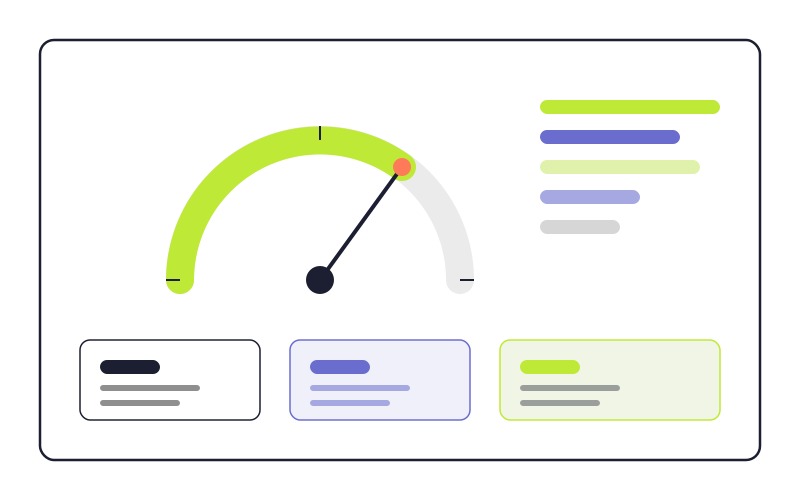
- Scores brand visibility across ChatGPT, Gemini, and Perplexity on a 100-point scale
- Weights 5 dimensions: Sentiment (40%), Presence Quality (20%), Brand Recognition (20%), Share of Voice (10%), Market Competition (10%)
- Runs prompts daily, tracks citation frequency
- Breaks down which domains and content types are getting cited
- Surfaces prioritized recommendations
Tier inclusion:
- Marketing Hub Professional: 25 prompts/day
- Marketing Hub Enterprise: 50 prompts/day
The differentiator: CRM-powered prompt suggestions. AEO runs your tests against prompts grounded in your actual customer data — not generic categories.
Honest gap: HubSpot AEO doesn't yet track Google AI Overviews, Claude, or Microsoft Copilot. If those engines drive your category, you'll want a dedicated AEO tool alongside it.
Layer 5: Buyer Intent + Enrichment
The data layer that turns anonymous traffic into pipeline.
Standard contact and company enrichment is now included free with paid Core Seats — a meaningful upgrade from previous years.
What Buyer Intent surfaces:
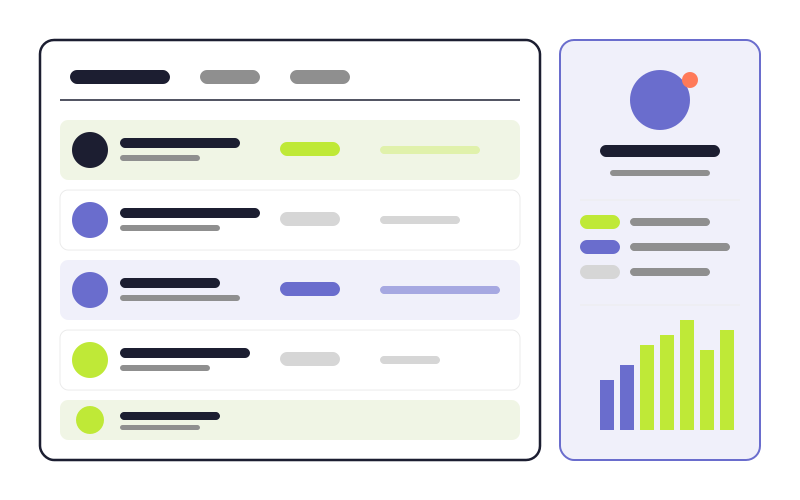
- Visitor Intent — companies visiting your high-intent pages
- Research Intent — companies researching your topics across the web
- Company News — funding rounds, hires, M&A, partnerships
- Contact-level signals — job changes, email bounces, role updates
That data flows into:
- Active segments
- Workflow triggers
- Lead scoring blends (fit + engagement + intent)
- ABM campaigns and dashboards
- LinkedIn Ads matched audiences
For B2B teams selling into defined ICPs, this is the layer that justifies the upgrade from Starter to Professional.
Want help configuring Buyer Intent, lead scoring, or AEO on your portal?
Talk to Nettly → about a HubSpot setup or audit engagement.
HubSpot Marketing Hub Pricing in 2026
HubSpot moved to seat-based pricing in 2024, and the model has now matured. The full breakdown lives on the official HubSpot pricing page — here's how each tier looks today.
| Tier | Price | Marketing Contacts | Email Sends/mo | Onboarding |
|---|---|---|---|---|
| Free | $0 | 0 | 2,000 (HubSpot branded) | None |
| Starter | $9–20/seat/mo | 1,000 | 5,000 | None |
| Professional | $800/mo (3 seats) | 2,000 | 20,000 | $3,000 |
| Enterprise | $3,600/mo (5 seats) | 10,000 | 200,000 | $7,000 |
HubSpot Marketing Hub Free
$0 forever. No contact limit on the CRM side, 2,000 monthly email sends with HubSpot branding, and a meaningful slice of the email, forms, and live chat tooling. The strongest free tier in the marketing automation category, full stop.
HubSpot Marketing Hub Starter
$9–20 per seat per month depending on promotional pricing. 1,000 marketing contacts, 5,000 email sends, basic automation, and the ability to remove HubSpot branding.
No mandatory onboarding fee.
HubSpot Marketing Hub Professional
$800/month for 3 Core Seats on annual billing, +$50 per additional seat. 2,000 marketing contacts, 20,000 email sends, 300 workflows, 100 custom reports.
Watch out: Mandatory $3,000 one-time onboarding fee, plus a 44× price jump from Starter. Model carefully before committing.
Read more: HubSpot Marketing Onboarding: The 2026 Guide for B2B Teams
HubSpot Marketing Hub Enterprise
$3,600/month for 5 Core Seats on annual billing, +$75 per additional seat. 10,000 marketing contacts, 200,000 email sends, 1,000 workflows, 500 custom reports, plus the full advanced feature set.
Onboarding: $7,000 one-time.
The third meter: HubSpot Credits
There's a third pricing dimension to know: HubSpot Credits.
These are the unified currency for AI features, enrichment, agent runs, and Data Studio syncs.
Allocation per tier:
- Starter: ~500 credits/month
- Professional: ~3,000 credits/month
- Enterprise: ~5,000 credits/month
Overage: $10 per 1,000 credits (annual) or $0.010 per credit (pay-as-you-go).
Important: Credits don't roll over month to month. Configure your AI workflows and Auto-Add intent settings carefully — it's possible to burn through an Enterprise allocation in a single week.
HubSpot Marketing Hub vs. Other Marketing Platforms
Here's how Marketing Hub stacks up against the main alternatives.
| Platform | Best For | Entry Price | Notes |
|---|---|---|---|
| HubSpot Marketing Hub | Mid-market B2B (50–500) | $9/seat (Starter), $800/mo (Pro) | Strongest all-in-one + native CRM. Best AI integration. |
| Marketo Engage | Enterprise B2B (1,000+) | ~$2,000/mo | Deeper enterprise depth. Steeper learning curve. |
| Pardot (Marketing Cloud Account Engagement) | Salesforce-entrenched B2B | ~$1,500/mo | Best for Salesforce shops needing real-time bi-directional sync. |
| Klaviyo | DTC ecommerce / Shopify | $20/mo (1,500 contacts) | Best for transactional + behavioral email. |
| ActiveCampaign | SMB email + automation | $9/mo (1,000 contacts) | Cheaper. No native CRM depth. |
Bottom line:
- HubSpot Marketing Hub wins on time-to-value, ease of use, and integrated CRM
- Marketo wins on enterprise depth and complex multi-program architectures
- Pardot wins for Salesforce-entrenched orgs
- Klaviyo wins for Shopify DTC
- ActiveCampaign wins for cheap, CRM-light email
Frequently Asked Questions
What is HubSpot Marketing Hub used for?
HubSpot Marketing Hub is used for marketing automation, email campaigns, landing pages, lead generation, social media management, ad tracking, attribution reporting, and AI-driven content creation — all on a shared CRM with HubSpot's Sales and Service Hubs.
How much does HubSpot Marketing Hub cost?
HubSpot Marketing Hub costs $0 (Free), $9–20 per seat per month (Starter), $800/month for 3 seats (Professional), or $3,600/month for 5 seats (Enterprise). Professional and Enterprise both require one-time onboarding fees of $3,000 and $7,000 respectively. See the official HubSpot pricing page for current rates.
What's the difference between HubSpot Marketing Hub and HubSpot CRM?
HubSpot CRM is the free customer database that stores contacts, companies, and deals. HubSpot Marketing Hub is the paid marketing automation product that runs on top of the CRM — adding email, automation, landing pages, ads, and AI tools.
Is HubSpot Marketing Hub good for B2B?
Yes. HubSpot Marketing Hub is purpose-built for B2B marketing teams, with strong support for lead scoring, ABM, multi-touch attribution, and integration with Sales Hub. It's been named a Leader in the Gartner Magic Quadrant for B2B Marketing Automation 5 years running.
Can I use HubSpot Marketing Hub for free?
Yes. HubSpot Marketing Hub Free includes basic email marketing, forms, live chat, and the full CRM at no cost — with HubSpot branding on emails and a 2,000-email monthly limit. You can sign up free directly with HubSpot.
What is Marketing Studio in HubSpot?
Marketing Studio is HubSpot's AI-powered campaign workspace inside Marketing Hub Professional and Enterprise. It replaces the older Campaigns tool with a visual canvas where you can plan, build, execute, and measure full campaigns — with AI generating assets from a single brief.
What is HubSpot AEO?
HubSpot AEO (Answer Engine Optimization) is a tool inside Marketing Hub that tracks and improves your brand's visibility in AI search engines like ChatGPT, Gemini, and Perplexity. It scores brand visibility on a 100-point scale and runs daily prompt tests using your CRM data.
What's the cheapest way to get HubSpot Marketing Hub?
The cheapest way to access HubSpot Marketing Hub is the Free tier ($0) for basic features, or the Starter tier ($9–20 per seat per month) for the ability to remove HubSpot branding. Avoid the 44× jump to Professional unless you genuinely need lead scoring, advanced workflows, and Marketing Studio.
Get Started With HubSpot Marketing Hub
Here's the short version.
HubSpot Marketing Hub is the deepest native integration of marketing automation, AI agents, intent data, and answer-engine optimization in any commercial marketing platform — sold at mid-market prices, on a CRM your sales team will actually use.
For B2B teams in the 50-to-500-employee range, it's the strongest all-in-one option on the market.
The questions worth asking aren't "is HubSpot Marketing Hub good enough at email and workflows?" anymore. They're:
- How well will this convert AI-mediated buyer research into pipeline?
- Which tier actually fits where we are right now?
That second question is where most teams trip up.
Book a 30-minute intro call with Superwork →
We'll walk through your current marketing stack, your buying motion, and the right HubSpot Marketing Hub configuration for your team — onboarding fees, seat math, and credit allocations included. No pitch.