You're here because your marketing team is about to make a HubSpot vs Marketo decision you'll live with for the next five years — and the vendor pages aren't giving you a straight answer.
Here's the straight answer: in 2026, this decision isn't about raw capability. Both platforms run serious enterprise marketing programs.
The real question is which one fits how your team actually operates. How fast you need to launch. How many specialists you can hire. How much AI you want in daily workflows. And whether your CRM lives next to your marketing automation — or inside it.
This guide walks you through where each platform leads, where each falls short, and how to pick the right one based on your team, your stack, and your budget.
In this guide:
- The marketing automation landscape shifted in 2026
- Where HubSpot Marketing Hub leads
- Where Marketo still wins
- The hidden cost of Marketo
- Pricing comparison
- Decision framework
- Migration playbook
- FAQ
The Marketing Automation Landscape Shifted in 2026
The short version: If your last platform evaluation was two or three years ago, throw away what you thought you knew about both products.
HubSpot shipped 200+ product updates at INBOUND 2025. Breeze AI, Breeze Agents, Marketing Studio, Answer Engine Optimization — the product is materially different from the tool it got labelled as for years.
Marketo got its biggest update since the Adobe acquisition at Summit 2025. A rebuilt email designer, deeper Experience Cloud integration, and GenAI features powered by Sensei and Firefly.
Both are Gartner Leaders. Both handle complex B2B programs.
The difference isn't capability ceiling anymore. It's operating model.
HubSpot wants to be the operating system your marketing, sales, and service teams share. One database. One UI. One vendor. AI agents that work across all of it.
Marketo wants to be the specialist marketing engine that plugs into your Salesforce instance and your Adobe stack. Built for teams with dedicated ops capacity and the technical resources to wire things together.
Which operating model you want is a more useful question than which platform has a longer feature list.
Where HubSpot Marketing Hub Leads in 2026
This is where the conversation has changed most since your last evaluation.
HubSpot's marketing capabilities in 2026 aren't a lighter-weight version of Marketo's. They're a different shape entirely.
Marketing Studio: Collaborative Campaign Builds
Marketing Studio is HubSpot's new home for campaign planning and execution.
You start with a campaign brief. Breeze generates the full asset set — emails, landing pages, social posts, ad copy, video scripts — all grounded in your CRM data and aligned to your brand voice.
Your team reviews, edits, and ships from the same canvas.
Why it matters: Marketo's program architecture was designed for a marketing ops specialist building campaigns alone in an admin UI. Marketing Studio was designed for a marketing team building together — with AI in the loop.
This shift reflects how modern HubSpot marketing teams actually work in 2026.
Breeze AI Agents That Replace Work
The Breeze Marketplace now includes 20+ pre-built agents. Four that matter most for marketing teams:
| Agent | What It Does |
|---|---|
| Content Agent | Drafts blog posts, landing pages, and campaign assets in your brand voice. Grounded in your CRM data — not generic LLM output. |
| Prospecting Agent | 24/7 inbound BDR. Researches companies, personalises outreach, qualifies leads before handing to a human. |
| Customer Agent | Handles pricing questions, demo requests, content recommendations. Published resolution rates above 65%. |
| Breeze Assistant | Platform-wide co-pilot. Drafts emails, summarises contacts, prepares meeting briefs. |
Breeze Studio lets you customise agents and build new ones on top of your HubSpot data — no developer required.
Marketo has GenAI through Sensei. Strong features, especially image generation via Firefly. But they're distributed across the Adobe stack rather than unified in one platform. Getting full value usually means buying additional Adobe products.
Built-In CRM: A Marketing Advantage
This is the point most comparison articles get wrong.
HubSpot's unified CRM isn't just convenient for your sales team. It's a structural advantage for your marketing team.
When marketing automation and CRM share one database:
- Lead scoring fires in real time (no sync delay)
- Email personalisation pulls from live deal stages
- Attribution reconciles to pipeline without manual cleanup
- The "marketing says 12,000 MQLs, sales says 8,000" debate disappears
Marketo syncs bi-directionally with Salesforce, and that sync is genuinely good after the Summit 2025 rebuild. But it's still a sync.
Every Marketo-to-Salesforce deployment we've seen has a governance document for custom object handling, field mapping, and conflict resolution. Someone on your team owns that document. That someone is not cheap.
Answer Engine Optimization (AEO)
HubSpot shipped an AEO tool in late 2025 — an industry first.
Google AI Overviews, Perplexity, ChatGPT search, Claude — your buyers are researching through these surfaces. Traditional SEO doesn't cover it. AI Overviews already appear in roughly 45% of Google searches and reduce organic clicks by up to 58%.
HubSpot's AEO tool scores your content for LLM citability and gives specific recommendations on structure, entity markup, and factual density.
Marketo hasn't shipped an AEO equivalent. Its built-in SEO tool was deprecated in March 2026.
If AI search is part of your strategy, that's a gap you can't ignore.
Multi-Touch Attribution — Included
HubSpot ships six attribution models out of the box: first-touch, last-touch, linear, U-shaped, W-shaped, and time-decay. Full Path attribution is added at Enterprise. No add-on. No separate product.
Marketo's native reporting is program-focused. Serious multi-touch attribution requires Marketo Measure (formerly Bizible) — a separate product estimated at $40,000–$60,000+ per year on top of Marketo Engage.
Most teams layer a BI tool on top of that for the flexibility their board wants. If attribution is a priority for your team, our guide to marketing attribution in HubSpot breaks down how to set up all six models.
Time to Launch: Weeks, Not Months
Across our clients, HubSpot Marketing Hub deployments typically run live campaigns within 3–6 weeks.
Marketo deployments in the same segment take 3–6 months — with consulting support that adds $10,000–$50,000 on its own.
If your CMO has quarterly pipeline targets, the difference between "live in April" and "live in August" is the difference between hitting the number and explaining why you didn't.
Thinking about moving to HubSpot? Book a working session with Superwork — we'll walk through your stack and tell you whether HubSpot Marketing Hub is the right call. Read more about HubSpot's marketing capabilities first if you want the full picture.
Where Marketo Still Wins (The Honest Section)
We'd be a lousy consultancy if we told you HubSpot wins every scenario. It doesn't.
There's a specific profile where Marketo is the right answer. Here's where it earns its price tag.
Multi-Dimensional Program Architecture
Marketo's program hierarchy is genuinely better for matrix organisations.
If you're running coordinated ABM across multiple product lines, regions, and buyer stages — where the same account sits in a "Product A North America upsell" program and a "Product B EMEA new logo" program simultaneously — Marketo handles that natively.
HubSpot's campaign model has closed most of this gap. Not all of it.
Unlimited Custom Score Fields
Marketo lets you create separate score fields for demographic fit, behavioural engagement, product interest — without object-type constraints. Stack and compose them however you want.
HubSpot Enterprise now includes AI-powered predictive scoring, but ceilings on custom score fields still matter for multi-model scoring at scale.
Deep Salesforce-Native Sync
If Salesforce is the unmoveable centre of your revenue operation — fifteen custom objects, four years of custom code, a dedicated admin team — Marketo's connector is purpose-built for that environment.
The integration is native in a way HubSpot's Salesforce sync (good and functional) isn't architecturally.
Velocity Scripting
For teams with a developer, Marketo's Velocity scripting and REST API give you raw programmatic control that HubSpot's more opinionated UI doesn't match.
Most marketers don't need this. The ones who do know they need it.
Full Adobe Stack Integration
If you're standardised on Adobe Experience Cloud — AEM, Real-Time CDP, GenStudio — Marketo fits that ecosystem in a way HubSpot doesn't. Shared identity graph, cross-product GenAI, integrated creative workflows.
The profile where Marketo wins: 1,000+ employees. Salesforce-committed. Adobe-committed. Two or more full-time marketing ops specialists. Complex multi-region governance. Budget for $150,000+ in year one.
That's real. It's just not most marketing teams reading this.
The Hidden Cost of Marketo: Marketing Ops as a Job Description
Here's what most comparison articles leave out.
Running Marketo well is a full-time job for at least one person, often two.
Every mid-market Marketo deployment we've worked with has a dedicated admin — usually certified, often with experience at another Marketo shop. The learning curve is measured in months. Certification is a real credential.
The platform rewards expertise. It penalises teams that don't have it.
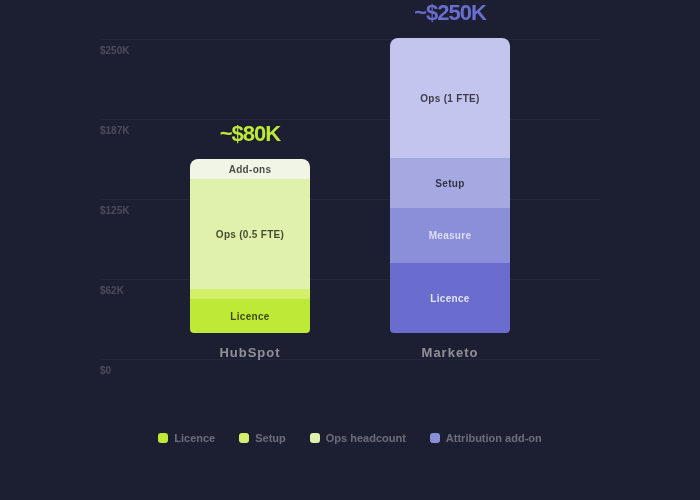
Year-One Budget Reality (Mid-Market)
| Cost | HubSpot (Professional) | Marketo (Select/Prime) |
|---|---|---|
| Platform licence | ~$10,700/yr | $40,000–$100,000+/yr |
| Attribution add-on | Included | $40,000–$60,000+/yr (Measure) |
| Implementation | $3,000 | $30,000–$75,000+ |
| Ops headcount | 0.5 FTE (~$35,000) | 1 FTE (~$95,000) |
| Consulting retainer | Optional | $24,000–$120,000/yr |
| Year-one TCO | ~$80,000 | $150,000–$250,000+ |
The gap isn't sticker price. It's the operational overhead of treating marketing automation as a specialist discipline versus something your existing team runs.
Neither answer is wrong. But you should know which one you're signing up for.
Getting quoted for Marketo? Talk to Superwork — we'll run the numbers with you honestly, including the scenarios where Marketo is the right call.
HubSpot vs Marketo Pricing in 2026
Here's the side-by-side with numbers you'll actually see quoted in 2026.
| HubSpot Marketing Hub | Marketo Engage | |
|---|---|---|
| Starting price | $20/mo per seat (Starter) | Quote-based (call required) |
| Mid-market tier | $890/mo (Professional) | ~$3,000–$5,000/mo (estimated) |
| Enterprise | $3,600/mo | $100,000+/yr typical |
| Implementation | $3,000 (Pro) / $7,000 (Enterprise) | $30,000–$75,000+ |
| Onboarding time | 3–6 weeks | 3–6 months |
| CRM | Built-in, unified | Requires Salesforce or separate CRM |
| Attribution models | 6 included | Separate purchase (Measure) |
| Ease of use (G2) | 8.6 / 10 | 7.1 / 10 |
| Ops headcount | 0.5 FTE typical | 1–2 FTE typical |
| Year-one TCO | ~$80,000 | ~$200,000+ |
Important nuance: HubSpot's contact-based pricing escalates as your database grows. Add-ons (transactional email, dedicated IP, extra seats) stack up. Marketo scales through database capacity renegotiations and API overages.
Neither is cheap at scale. HubSpot just shows you the numbers before you talk to a salesperson. For a full cost breakdown across all Hubs, see our HubSpot total cost of ownership guide.
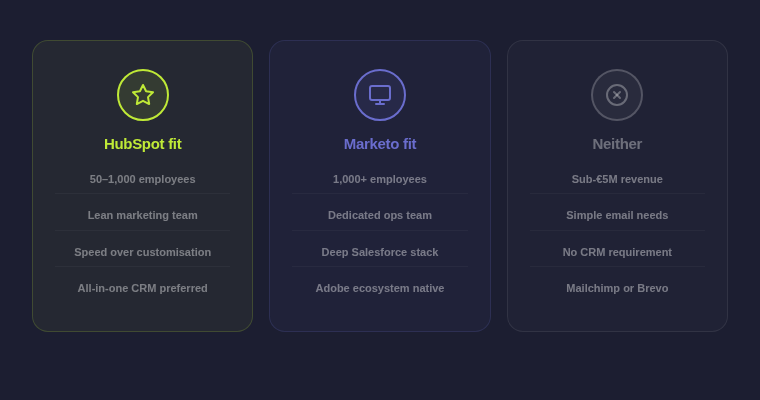
The Decision Framework: Who Should Pick What
Skip the feature matrices. The HubSpot vs Marketo decision comes down to three profiles.
Pick HubSpot
You're a growing B2B company (50–1,000 employees) that wants marketing, sales, and service on one platform. AI agents built in. Transparent pricing. A team that launches campaigns without hiring specialists.
This is roughly 80% of the mid-market. You'll go live faster, pay less, and keep your marketing team focused on marketing — not maintaining an automation platform.
Explore the full HubSpot marketing platform breakdown to see what you'd be working with.
Pick Marketo
You're an enterprise (1,000+ employees) with a mature Salesforce instance, committed Adobe stack, dedicated marketing ops headcount (1–2+ FTE), and complex multi-region governance needs.
The investment is real. So is the capability. This is the right answer for a specific type of organisation — global, Salesforce-first, ops-heavy.
The Mistake We See Most Often
Mid-market companies buying Marketo because the sales deck was more impressive — then spending 18 months underutilising 70% of the platform because they never hired the ops team to operate it.
Enterprise pricing with SMB usage patterns. The worst of both worlds.
If You're Migrating from Marketo to HubSpot
The migration is real work. You're moving programs, smart lists, custom fields, lead scores, and attribution logic between fundamentally different data models.
We budget 8–14 weeks for a mid-market migration. The effort concentrates in three areas:
1. Data architecture translation. Marketo programs don't map 1:1 to HubSpot campaigns. You rethink the taxonomy — not just re-platform it.
2. Scoring model rebuild. Marketo's unlimited custom score fields collapse into HubSpot's framework. Usually a healthy simplification — but a change your ops team owns.
3. Attribution reconciliation. Historical Marketo Measure data doesn't transfer cleanly. You'll have a cutover moment where year-over-year reporting breaks for a cycle.
Teams that migrate successfully treat it as a chance to clean up governance debt — the unused programs, zombie smart lists, scoring rules nobody remembers writing.
Teams that struggle try to lift-and-shift everything and end up with the same mess in a new UI.
Considering the switch? Get in touch with Superwork — we do this every week and can give you a realistic scope before you commit.
The Bottom Line
The gap between HubSpot and Marketo used to be about capability. In 2026, that gap has mostly closed.
The real differentiator is operating model, not feature count.
If you want a unified platform with AI agents, transparent pricing, and a launch timeline measured in weeks — HubSpot Marketing Hub is the clear pick for the majority of mid-market B2B companies. And increasingly defensible at the enterprise level.
If you're a large enterprise with a Salesforce-first, Adobe-committed stack and the ops headcount to match — Marketo still earns its price honestly.
Know which profile you are before you sign. The platform you can actually deploy and operate will always outperform the one that looked better in the sales deck.
Ready to decide? Book a working session with Superwork — we'll look at your stack, your team, and your goals, and give you an honest recommendation. Including the cases where it isn't HubSpot.
Frequently Asked Questions
Is HubSpot good enough for enterprise marketing in 2026?
Yes. HubSpot Marketing Hub Enterprise now includes multi-touch attribution (six models), account-based marketing tools, custom objects, AI-powered predictive scoring, and the Marketing Studio collaborative canvas. It's a Gartner Leader for the fifth consecutive year. The "HubSpot is just for SMBs" argument hasn't been accurate since roughly 2023.
How much does Marketo actually cost per year?
Adobe doesn't publish Marketo pricing. Industry estimates put mid-market deployments at $40,000–$100,000+ per year for the platform licence alone. Adding Marketo Measure (attribution), implementation, and a required dedicated admin, realistic first-year total cost of ownership is $150,000–$250,000+.
Can HubSpot replace Marketo for B2B lead scoring?
For most B2B companies, yes. HubSpot Enterprise includes contact and company scoring with AI-powered predictive models. The gap narrows every release. Marketo's advantage is unlimited custom score fields with no object-type constraints — relevant if you run genuinely complex multi-model scoring across product lines.
How long does a Marketo-to-HubSpot migration take?
Typical mid-market migrations take 8–14 weeks. The work concentrates in data architecture translation, scoring model rebuilds, and attribution reconciliation. Lift-and-shift approaches fail. Successful migrations rethink the taxonomy and use the move to clean up governance debt.
Does HubSpot integrate with Salesforce?
Yes. HubSpot's Salesforce integration syncs contacts, companies, deals, and activities bi-directionally. It's functional and reliable. Marketo's Salesforce connector is more deeply native — relevant if your CRM has extensive custom objects and custom code. For most mid-market Salesforce instances, HubSpot's integration covers the need.
What is HubSpot's AEO tool?
Answer Engine Optimization (AEO) is a HubSpot tool launched in late 2025 that scores your content for how well AI search engines (Google AI Overviews, Perplexity, ChatGPT) will cite it. It provides specific recommendations on structure, entity markup, and factual density. No other major marketing automation platform has a comparable feature in 2026.